Building a theory of change model to support race equality in Professional Services


Across higher education, Professional Services (PS) play a critical role in shaping institutional culture, student experience and organisational effectiveness. Over recent years, the sector has made increasingly explicit commitments to race equality – for example the adoption by many institutions of the Advance HE Race Equality Charter. Yet for many PS colleagues from racially minoritised backgrounds, lived experience continues to lag behind the aspirations of the sector.
A recent AHUA-convened workshop, supported by the Institute for Knowledge Exchange Practice at Nottingham Trent University, brought together professional service colleagues including AHUA members and participants from the AHUA Reciprocal Mentoring Programme to build on the recent AHUA funded report “Career barriers and enablers for ethnically minoritised senior professional services roles in UK Higher Education” and to start to further explore this challenge using a Theory of Change approach. The purpose was not to rehearse familiar problems, but to move the conversation towards identifying clear actions and areas where sector and institutional change could add the most value.
The sector is not short of activity on race equality. Institutions have invested in leadership Programmes (e.g the White Rose Equity in Leadership / The Professional Services Leaders of Colour Programme – a pilot programme across universities in the Midlands), mentoring schemes (e.g. London Higher Global Majority Mentoring Programme), and inclusive recruitment initiatives. What is less clear is how these efforts connect, where responsibility sits, and whether collectively they are sufficient to disrupt long-standing patterns of inequality within Professional Service as work focused on equality in HEIs has historically focused more on the academic space.
A Theory of Change provides a structured approach to explore this. It enables discussion about the outcomes we are genuinely seeking, the systems and practices that need to shift, the assumptions we are making about how change will occur, and the resources needed to support this change.
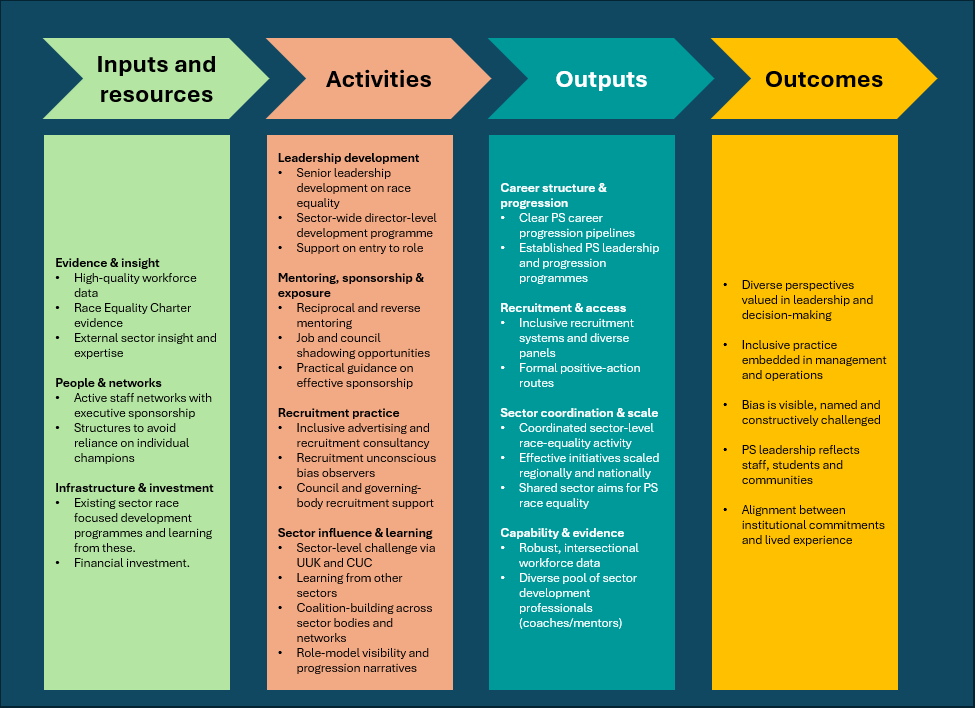
During the workshop we had structured discussions which aimed to captured what success might look like, the outputs that would support this success, the activities that institutions and the sector could take, and the resources that would be needed to support these activities.
The discussions highlighted that success is not defined solely by representation. The long-term ambition is a racially equitable Professional Services workforce, with leadership that reflects staff, students and communities, and with decision-making informed by diverse lived experience.
Key priorities identified included treating recruitment and progression as core organisational systems; making PS career pathways visible and credible; developing sponsorship as an active leadership capability; scaling activity through sector collaboration; and strengthening intersectional data. This was captured during the workshop in a draft logic model capturing how these changes might come about. At the heart of the discussion was an understanding that credibility in the change process requires alignment between institutional commitments and the lived experience of Global Majority staff.
To bring about change requires action, not just aspiration. AHUA is committed to changing the diversity of senior leaders and we will continue use the tangible levers within our remit including:
- Creating visibility around the structural challenges facing Professional Services colleagues from Global Majority backgrounds.
- Strengthen the leadership pipeline through practical support, including enabling participation from Global Majority colleagues in programmes such as ARCP.
- Use our convening power to bring senior leaders together across institutional and mission-group boundaries.
However, the logic model developed during the workshop makes something equally clear: this is not an issue that can be resolved by any single organisation or initiative. The barriers identified are structural, systemic and sectoral.
AHUA’s work should therefore be understood as a starting point, not a solution. Sustainable progress on race equality in Professional Services will depend on institutions and associations aligning effort, sharing learning and being prepared to act collectively where scale enables better outcomes. The question now is not whether the sector recognises the challenge. It is whether we are prepared to organise ourselves differently to bring about meaningful change.
Authors
Robin Henderson, AHUA Development Consultant
Dr Louise Oldridge, Dr Jessie Pswarayi and Dr Maranda Ridgway, Nottingham Trent University.
Related Blogs