Organisational Efficiency Maturity Assessment: trailblazers needed!

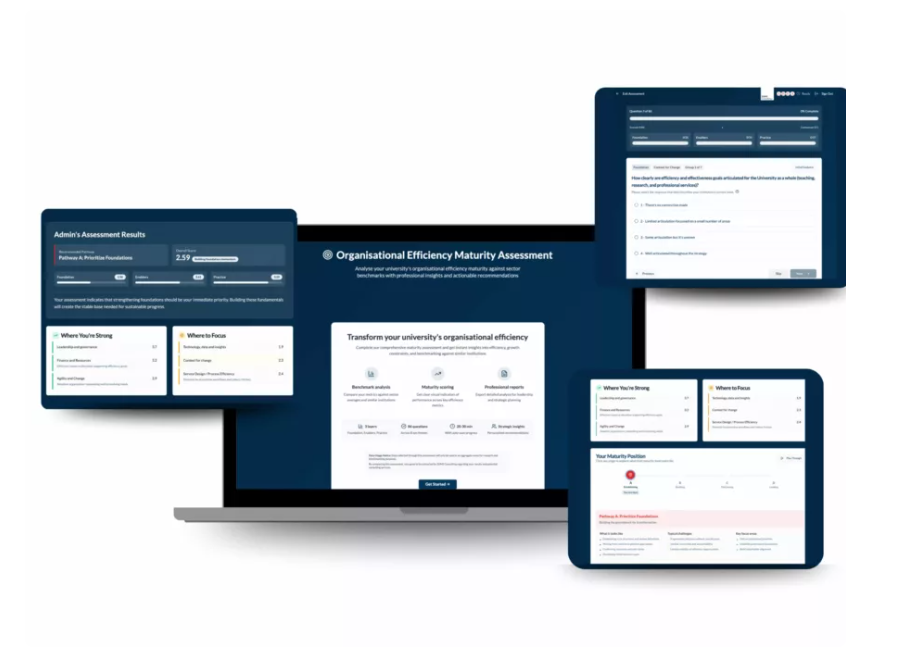
Register for free access here
In July 2025 the Universities UK Transformation and Efficiency Taskforce published its stage 1 report: Towards a new Era of Collaboration. The report signalled that the financial pressures on the sector would require collaboration between institutions to share solutions that nurture efficiency and change. One of the proposals in the report was to ‘ask the Association of Heads of University Administration (AHUA) to develop an organisational efficiency maturity model’.
The taskforce was established early 2025 as financial pressures grew across the sector and it was clear that long term efficiencies would be necessary. The taskforce recognised the need to develop a sense of efficiency that didn’t simply work out arbitrary targets to reduce the cost of functions through salami slicing but instead developed a model of efficiency that balanced operating costs against quality of education and student success.
In the 6 months since being set the challenge to develop an organisational efficiency maturity model, AHUA identified SUMS as a key development partner, established a steering group of practitioners from a cross section of institutions across the UK and a variety of mission groups. Together they refined the brief and developed a beta product for which we are now seeking ‘early adopters’.
The question we were trying to solve
The steering group spent time in early discussions exploring the art of the possible, particularly thinking about what would make the tool add real value and provide a resource for them that could be the catalyst for change. We recognised that the tool needed to simultaneously
- harness the power of creating a cross-sector picture that might allow elements of benchmarking and a sector wide picture of efficiency, and
- allow individual institutions to protect some of their own strengths and vulnerabilities in a competitive marketplace
We knew that, with a desire to move at pace, with SUMS and AHUA both working on the project on a pro bono basis, and a commitment that the product we develop would be free for all in the sector, we couldn’t compete with the long established frameworks and paid for benchmarking products that already existed. We agreed that we would initially launch a minimum viable product, securing a critical mass of participation that we would then review and take feedback from, before considering how the product could evolve further.
The solution
We decided on gamification principles for the efficiency assessment, with multiple choice questions and self-assessment against pre-set criteria that build up a profile at its conclusion. Imagine magazines you had as a teenager, when you answered multiple choice questions to identify your future career, life partner, or personality type. Then rewrite the questions around an efficiency methodology that you could apply to the institution you work in, with data outputs designed to show the strengths and weaknesses of your institutional efficiency, and key opportunities for the institution to consider in order to deliver sustainable and high performing efficiency. Do all of that and do it online rather than on the middle pages of a “Just 17” magazine, and that was our vision for the organisational efficiency maturity assessment.
The framework.
We identified 8 core characteristics that drive or hold back organisational efficiency:
- Vision and scope
- Finance and resources
- Service design and process efficiency
- People and culture
- Agility and change
- Data and insights
- Learning and benchmarking
- Leadership and governance
A series of just over 80 questions were built spread across these characteristics and for each question 4 possible answers carefully designed to be as widely applicable across as wide diversity of the sector as possible. Most of the questions are subjective judgements, with a handful that are more quantitative questions, with the 4 possible answers demonstrating a degree of confidence, capability or practice.
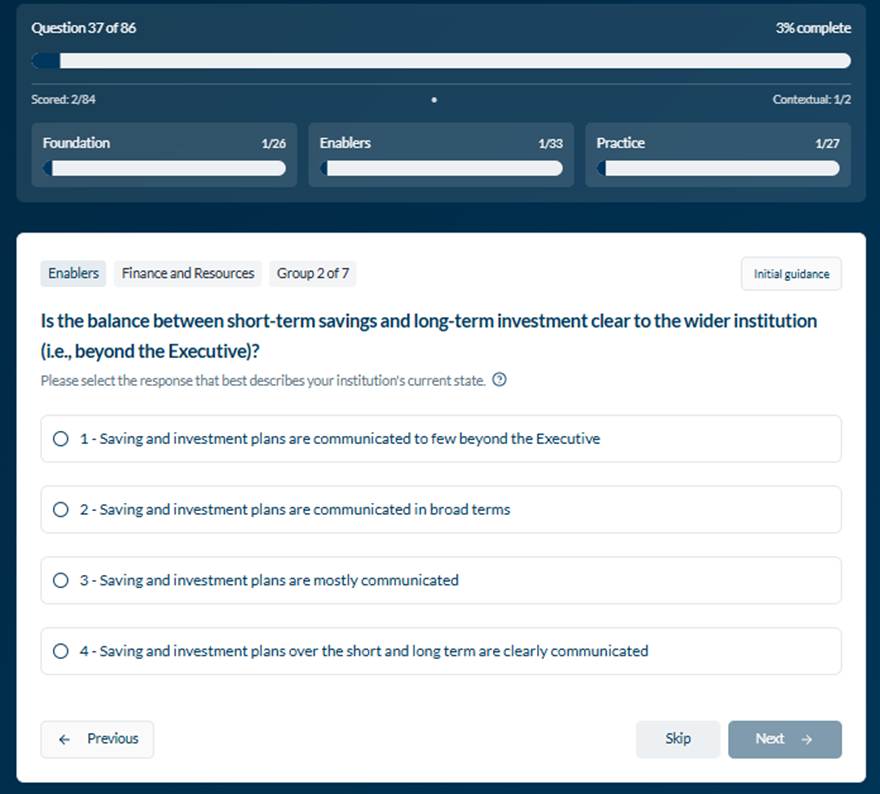
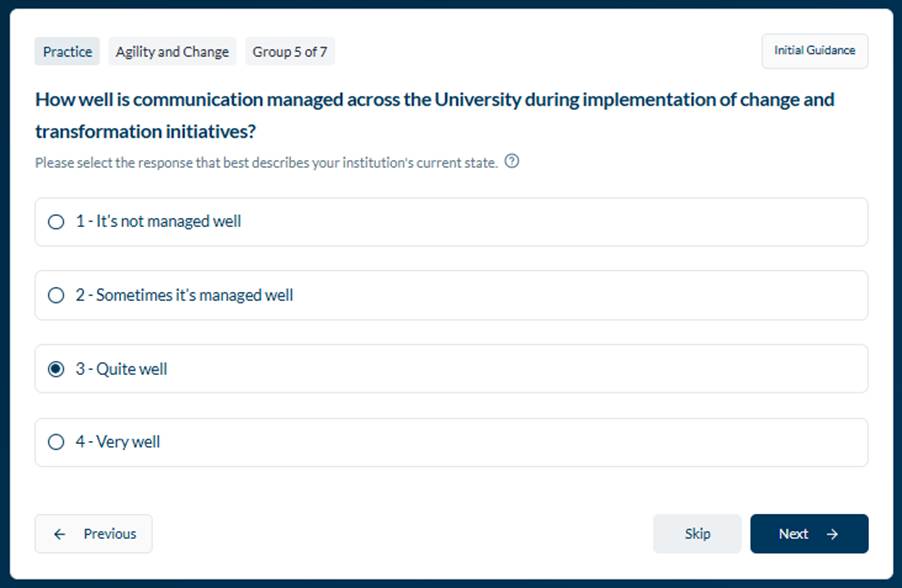
The questions are aimed at a cross organisational view from a senior leader. They capture, likely from an executive level, the perceived strengths and weaknesses of how they operate and the critical opportunities that might exist. With some subjective judgements required for questions, we imagine that an institution might choose to compare and contrast perspectives on operational efficiency amongst a small group of senior leaders. In some instances, they might seek input from others in the organisation, such as strategic planning and data teams, or those more closely associated with financial planning cycles.
The outputs
After responses to all questions have been completed, the tool generates an institutional report. Available online and to download, it shares a picture of the organisation’s strengths and weaknesses, some priorities, and pathways to improve organisational efficiency in key areas. As we grow a critical mass of participants, the benchmarking element will be added; initially against all other aggregate scores, with subsequent ability to benchmark against mission group or nation as the participant population grows. This benchmarking capability will not share specific and/or named institution’s data, though we could in future allow for other possible sector segmentation where a demand existed.
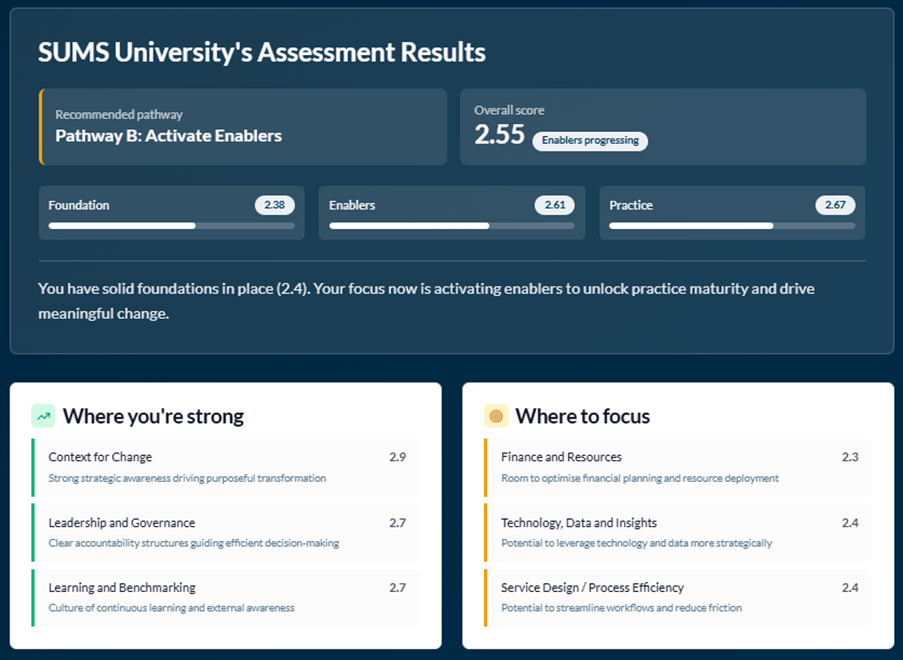
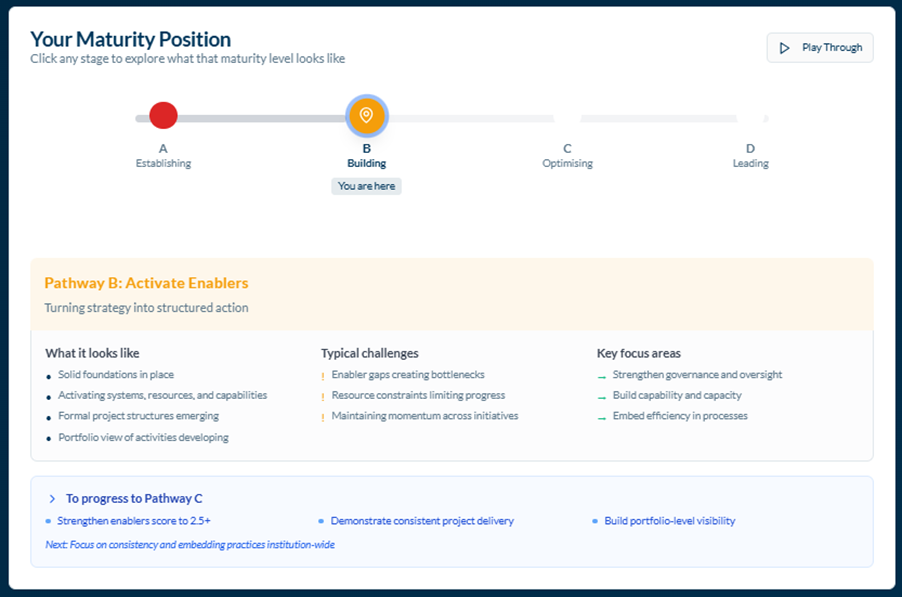
Individual institutional outputs will be the property of the institutional account holder, and we envisage they might be used in a variety of ways. A new VC, Registrar or Chair might use them to get an initial sense of the organisation’s efficiency characteristics for example. The report might form the basis for discussion between a VC, Chair and a Secretary then used to identify targets and priorities that will drive subsequent organisational efficiency.
Nationally we intend to use aggregated data to draw out anonymous case studies, identify key sector wide priorities, and explore themes and trends. We think the national picture might shape future work by sector bodies and associations that support the needs of the sector.
Find out more about the free to use tool and register for access to it for your institutions here
By Ben Vulliamy, Executive Director at AHUA and Nick Pidgeon, SUMS Managing Consultant (Business and Product Development)
Related Blogs