Reflections from a Canadian adventure


Canadian Universities traditionally tracked the rhythms in the States to try to foresee some of its own horizon. A second term for Trump though saw Canada decide to root its future elsewhere and strengthen connections wider afield. This was the context in which I was invited to speak at the Canadian Association of University Business Officers (CAUBO) conference this year. I was invited to share some of the UK policy context including reflections on the transformation and efficiency journey (a path they feel they increasingly share) but also giving me the chance to learn more about their system and the similarities and differences of our Canadian cousins.
The perception of a UK ‘high intensity’ degree
One of the first things I noticed as a toured and worked with a series of institutions was the contrasting degree structure. The 4-year degree is widely adopted and many Canadians view the UK approach as incredibly streamlined, perhaps somewhat ‘high stress’ and overly grades and exam focussed. Its perhaps a reminder that where some are calling for greater streamlining of the UK system with accelerated 2 year degrees, the motivations for this around cost saving and faster progression into careers may be at the expense of a broader student lifestyle, a program that can explore subject matter more broadly and students health and wellbeing.
‘Manchesterism’ and the Canadian provinces
The second thing you notice is how fragmented the Canadian sector is by the provinces. With regulation and funding led by the 10 provinces as opposed to the Canadian national government, the UK’s devolved nations look simple. I returned to the UK to confirmation that Burnham had won the Makerfield by-election, Starmer had confirmed plans to step down as the PM and with Burnham making speeches about a model of devolution that would make central government ‘more streamlined’ and ‘offer new opportunities to extend devolution in Scotland, Wales and Northern Ireland by taking power deeper down’. As I thought about what this new vision for ‘Manchesterism’ might mean and how power and responsibility might be pushed into regions I was struck that we might be wise to look at the challenges and opportunities presented by Canada’s provinces which can appear chaotic and fragmented but have also allowed Universities to work closely with local government on agendas shaped around the local need and relationships.
Shaping the opportunity beyond efficiency
Canada has started to explore the drive for efficiency earlier in the pressure of contracting income and increasing costs than we did in the UK. As a result they were perhaps avoiding some of the hazards and were mindful to avoid perpetual short term savings or ‘salami-slicing’, or efficiency savings that compromised quality and student outcomes. Canadian institutions are thinking more deeply about the efficiencies and changes that wouldn’t just deliver short term slivers of cost saving but take institutions towards more sustainable models that were routed in ideas about where they wanted to be in future.
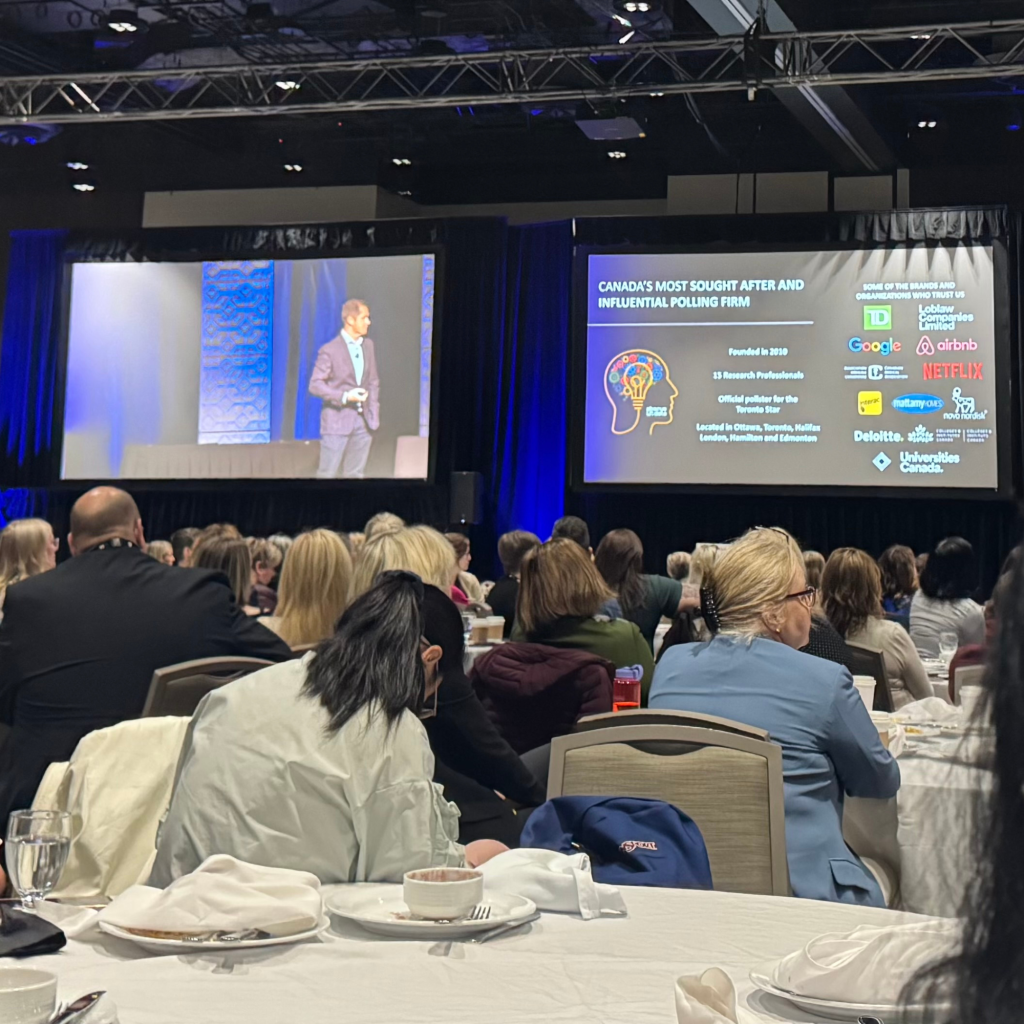
Institutions were not simply asking how generative AI might deliver cost savings, but how it can enhance pedagogy, influence future jobs and how it is perceived by young people. One particular conference keynote explored polling of young people showing deep mistrust of AI with an acceptance it would be part of their future professional life. They want to learn how to use AI for personal and public good and Universities could build that proposition. By flipping the lens through which AI would be considered in the Universities, away from efficiency and towards pedagogy, jobs and responsible engagement, they were able to think more ambitiously about its deployment. By asking how AI could enhance learning and research rather than drive efficiency, they were scoping projects that would often also leverage new income and / or deliver cost savings.

Moving beyond a students basic needs
The other advantage of creating space for thinking about the long-term future beyond efficiencies was that deeper questions were being asked about the current and future motivations of students. Like the UK many universities are trying to reassure students about how their basic needs will be met with evidence of food banks, bursaries and emergency student support similar to that we see in the UK. If I put this range of activity against a Maslow’s hierarchy of need, I would argue that a huge amount of time and money is being spent on trying to reassure students that their basic needs will be met while studying. That students will be able to eat and have a roof over their head in a safe environment.
For a generation Universities offered the chance for students to ‘discover themselves and the world around them’, set out how their students would ‘become global citizens’ or how they would ‘have a transformational experience’. If we become excessively preoccupied about delivering basic needs and communicating the support to ‘help you get by’ we risk devaluing the real and more aspirational pursuit of learning. If university offers only to put a roof over my head and provide a meal when I’m hungry I probably wouldn’t take on a debt of considerable amount to go there. University needs to offer me both support to meet my own basic needs and to show me how studying will help me experience love and belonging, grow my esteem and reach some self-actualisation at the higher end of Maslow’s hierarchy of need.
What does this mean for the UK?
Duncan Iverson was asked on the BBC Today Programme recently about his experience working with Andy Burnham in Manchester and what he thought Manchesterism might mean. And said ‘it can be summed up in 2 words: place first. Start with the place you’re in and organise around it the things people need to live good lives: good schools, transport, health, skills, and opportunity. Then start to move beyond the anger, resentment, anxiety and distrust that is becoming so characteristic of our politics, Make people’s lives better, from the ground up’.
My key take away from Canada is that we need to start to craft a vision for the future of UK HE that is both transformative and efficient. A vision that support students and communities basic needs making their own lives better and the world around them better. If we can get this right as Andy Burnham explores and build out his vision there could be a strong coalition formed that goes beyond efficiency and deeper into transformation.
Related Blogs