What the OEMA is telling us about Organisational Efficiency

Introduction
It’s now five months since the Organisational Efficiency Maturity Assessment (OEMA) launched. During that time, we have seen a great deal of enthusiasm from institutions to participate and the benefits to them and the sector as a whole are beginning to crystallise.
This blog looks at the OEMA story so far, and gives first sight of the sector level dataset including early indications of how we anticipate this can be used to support advocacy work. The OEMA is here, and it’s proving its worth. Now we want to take it to the next level. More institutions using it to drive change, along with insights drawn from a wider sector-level dataset.
What is the OEMA?
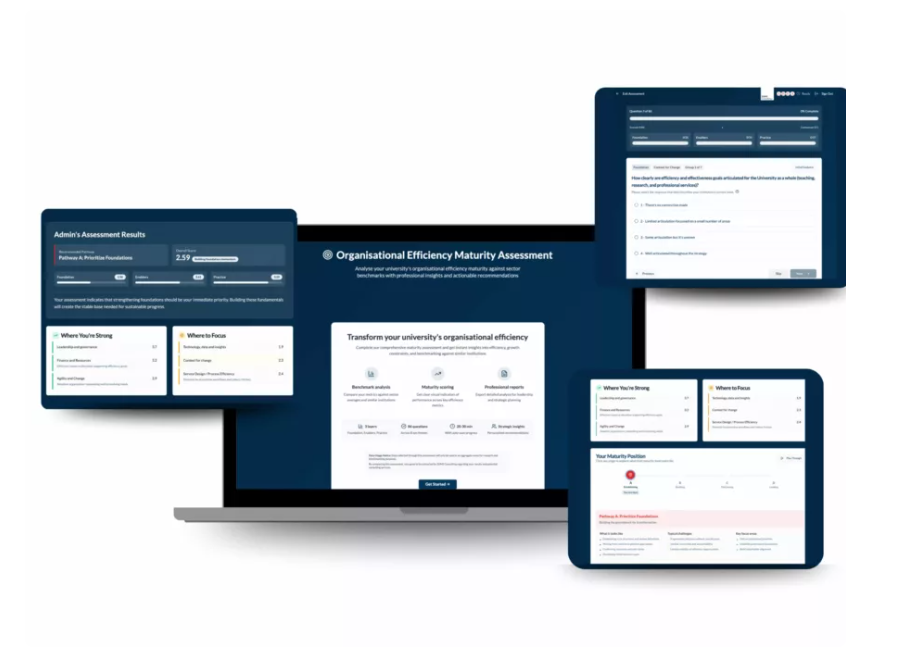
The OEMA is a powerful tool that helps UK Higher Education Institutions assess their maturity with respect to organisational efficiency. How well are they set up to drive efficiency in their operations, culturally, behaviourally, and from a process and governance perspective?
Since February, we’ve seen positive take-up of the OEMA. 55 institutions have registered to use the OEMA tool, and a critical mass has now completed the survey (some through SUMS-facilitated completion), representing a true cross-section of UK HE providers.
Benefits for institutions
Participating universities are benefitting from data points showing their maturity across eight organisational themes:
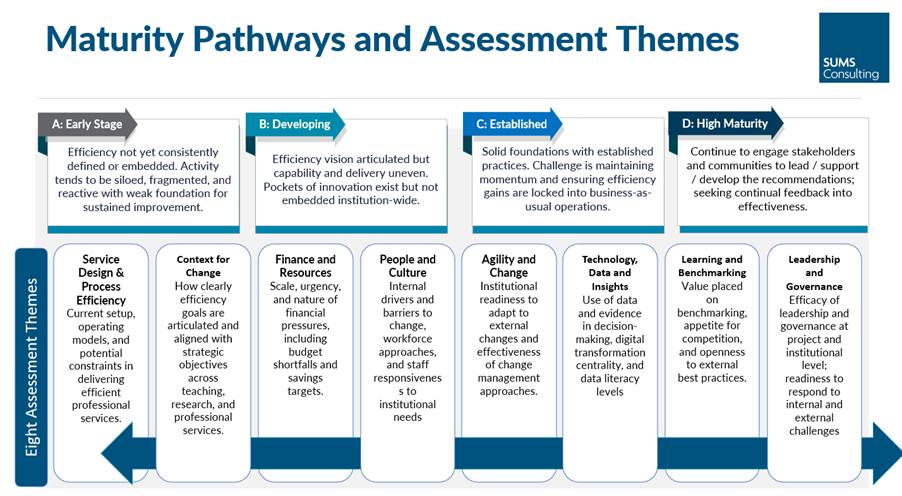
Figure 1: OEMA themes & maturity pathways
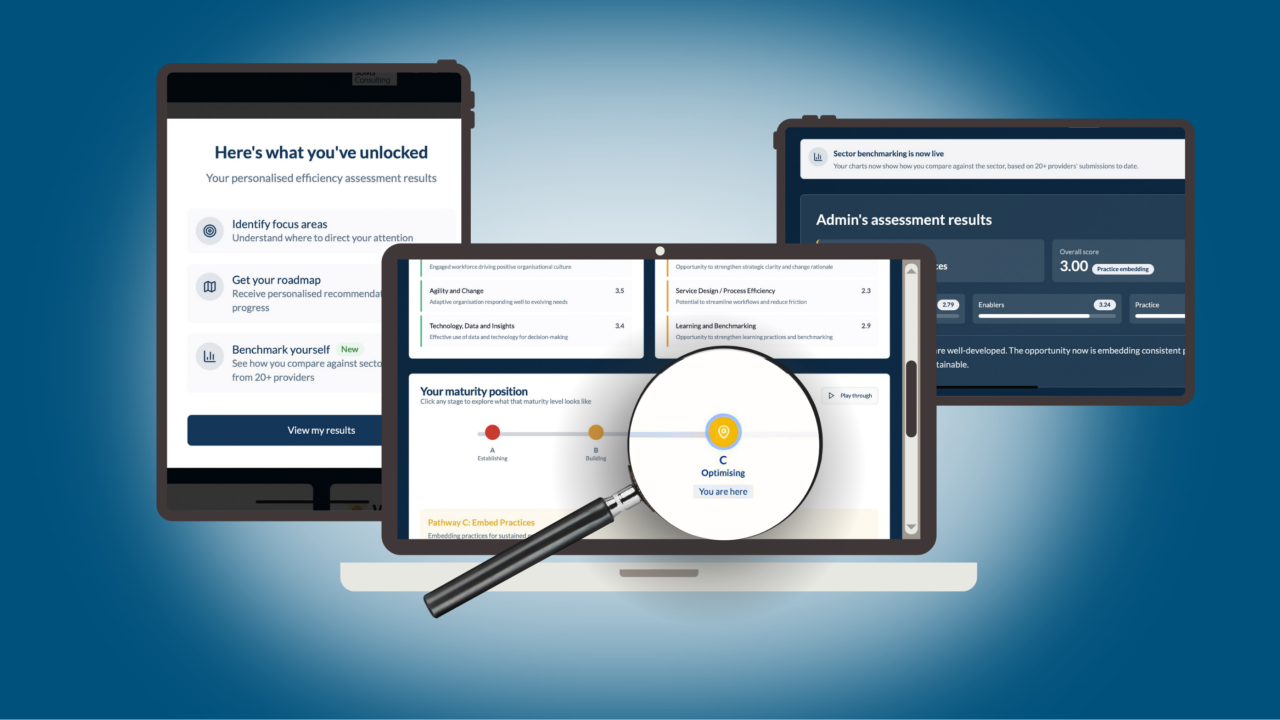
Average scores for each theme highlight areas of relative maturity or weakness, and the overall average score places each university on one of four “maturity pathways” (see Figure 1 above). Universities can then drill into the data to see exactly what’s going on. For example, for “Technology, Data and Insights” what could be causing a low score? Is it inaccessible data, or poor system integration?
Institutional leaders have been finding the insights gained from the OEMA invaluable as a way to take stock of maturity. We have seen rich conversations emerging through the post-assessment workshops we have run for university management teams. The OEMA acts as a catalyst to generate meaningful dialogue about how universities can be better prepared to become more efficient in the long term. For example, with one university we spoke at length about the need to challenge staff under-performance more consistently; a conversation which resulted directly from the “People and Culture” section of the OEMA.
Early sector-level data
We now have sufficient participation to begin to take a look at the aggregate data.
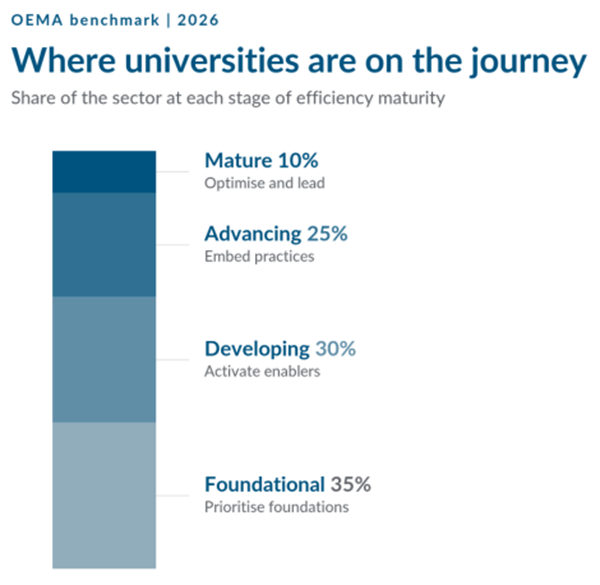
Figure 2: Early sector insight – overall maturity of the sector
65% of participating institutions find themselves in maturity pathways A or B (foundational or developing). This shows refreshing honesty from institutions. They see the value in using the OEMA as an opportunity to hold up a truthful mirror to institutional maturity, which is a positive outcome – after all, the first step in self-improvement is recognising that you need to improve. However, if that trend were to be reflected once we have a larger proportion of the sector represented in the data, it would point to a systemic lack of maturity. If that proves to be the case, a low level of change maturity will severely hamper attempts to transform the sector, no matter how innovative and radical the solutions.
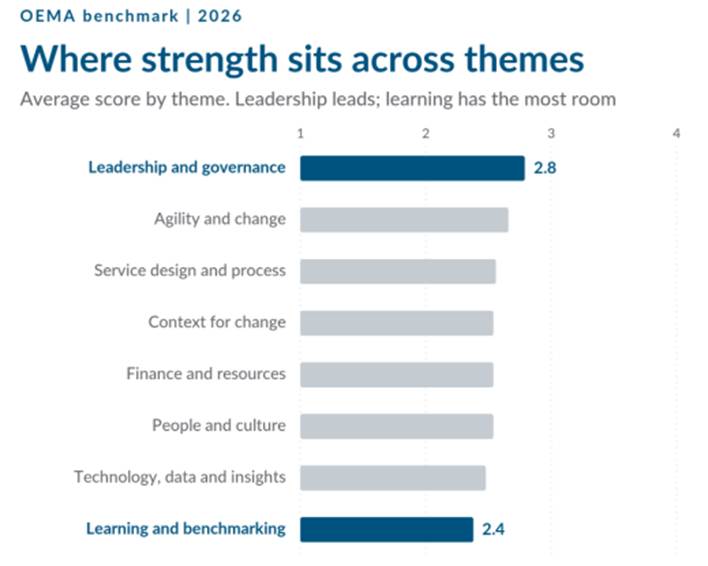
Figure 3: Early sector insight – average scores per OEMA theme
Looking at average scores across the themes from the aggregate dataset, “Leadership and Governance” is the highest scoring theme – a positive result. Less positive is the performance of “Learning and Benchmarking” with respect to looking outwards to see how to improve. And we would all hope that “Technology, Data and Insights” would score higher – technology isn’t the only way to improve efficiency, but it is inevitably and necessarily a big piece of the puzzle.
How aggregated data speaks to national agendas
One of the ambitions for the OEMA has been to identify common threads from the data that might help shape national agendas. Data that can help focus the work of sector bodies, government or the regulator and provide a better operating context for universities to deliver long term public benefit within.
We have started to use the aggregated data to illustrate the link between sustainability and operating context in AHUA’s liaison with sector bodies. In particular we feel that the early data suggests:
- That the need for rigour and confidence in long term financial planning needs to improve and, inevitably, there’s a relationship between financial planning and the wider policy environment. For example, delays to the strategic priorities grant letter or in confirming the mechanism by which the government intends to link fees to inflation erode the quality and confidence of planning. Long term financial modelling becomes excessively dependent on unknowns. This can adversely impact risk appetite, confidence about the availability capacity to invest in change.
- The breadth of reporting means that the sector has a growing data set but less capacity to use that data well and ensure it becomes embedded in good quality planning, review and informing key strategic decisions that are aligned to wider UK strategic priorities. We need to ensure that the data we produce directly impacts key strategic decisions and the quality of operations. Reporting should be clearly aligned to strategic priorities for providers and the sector / government more broadly.
- Finally, we see evidence that there are tensions and inefficiencies in competing decision-making processes and authorities within institutions. In order to be efficient, we need to ensure we can rapidly engage the different stakeholders but in ways that don’t complicate, slow down, and add cost burden to change. We need structures (for example single design authorities, and efficient operating models), relationships and a culture that can rapidly bring people together around key projects. This is about both internal relationships (between boards and executives, senate, and council etc) and external ones (with trade unions, regulator, government, local authority etc).
What’s next
We want to further increase participation in the OEMA, enabling us to add segmentation to the benchmarking, gain deeper insights for institutions, and show the cycles of evolution from one year to the next. We are committed to sharing the outputs clearly and widely, but we need providers to generate that data by playing their part.
Background
The OEMA was commissioned in the stage 1 report from the UUK Transformation and Efficiency Taskforce. The report, Towards a new era of collaboration, published in June 2025 commissioned a range of projects to be designed and delivered in order to respond to the need for transformation and efficiency in and across the sector. Opportunity realised 5 (see page 46 and 47 of the UUK report) was the specific commission for an OEMA proposing that we can support the transformation journey and sectors efficiency by ‘Adopting a common approach to assessing efficiency and benchmarking costs’.
AHUA were tasked with leading the development and in Summer 2025 we agreed, following a tender process, a memorandum of understanding to work with SUMS Consulting who kindly provided their expertise on a pro-bono basis as the charitable sector specialists to support the project. It was agreed that the tool would be made available on an open-source basis, free to use for sector institutions.
A project development steering group was selected from amongst AHUA membership bringing together 14 institutional leaders. These were executive level leaders holding governance, operations, transformation and change portfolios and they were selected as representing England and the devolved nations, all mission groups and nonaligned institutions and included an independent institution giving some significant breadth of insight.
Authors: Ben Vulliamy, Executive Director at AHUA, and Nick Pidgeon, Managing Consultant at SUMS
Related Blogs